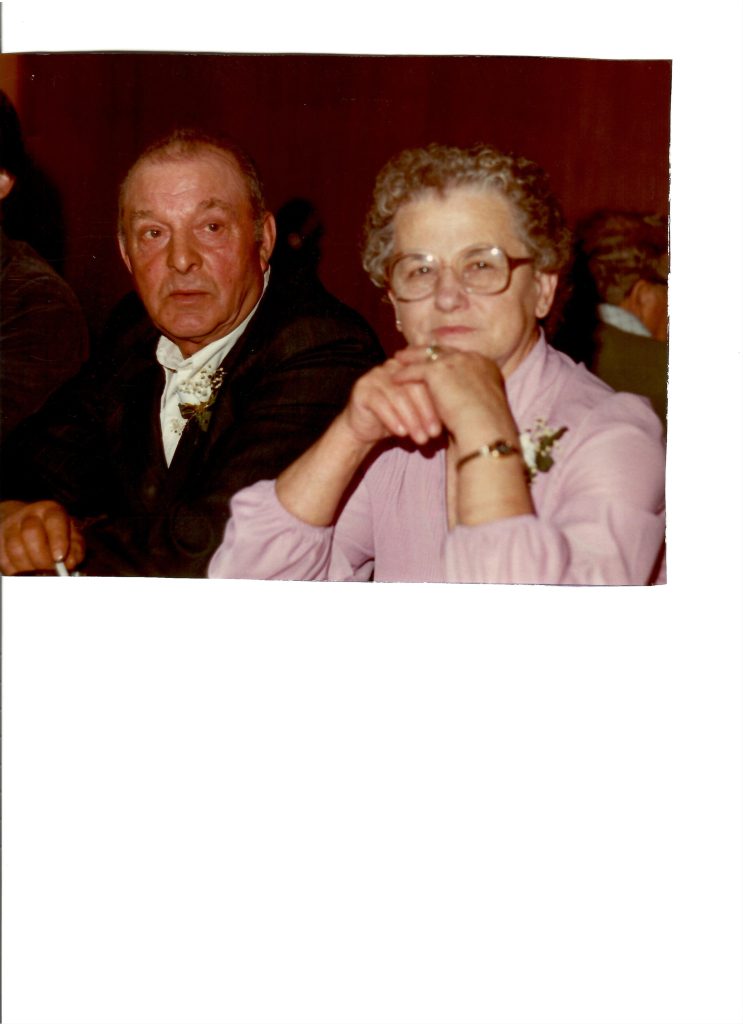
October 8, 1949, Ronald Liepert was born in Saltcoats Saskatchewan to Fred Henry and Helen Elizabeth (Hudak). Fred, of German heritage, was a middle child of 13 with his parents immigrating from Russia with the first 4 children several years before Fred was born in 1920.
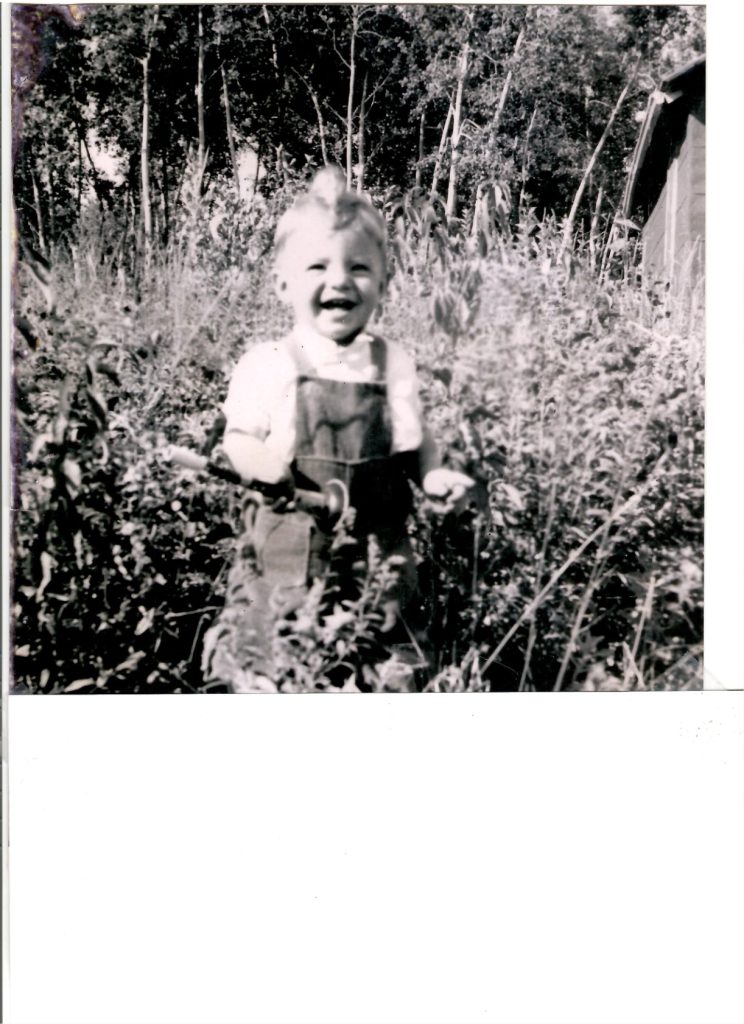
Helen immigrated to Canada from Budapest, Hungary in 1929 when she was 2. Fred spent a few years in the army during World War 2 but never left Canada. Helen was a farm wife, and each had the equivalent of about a grade 8 education.
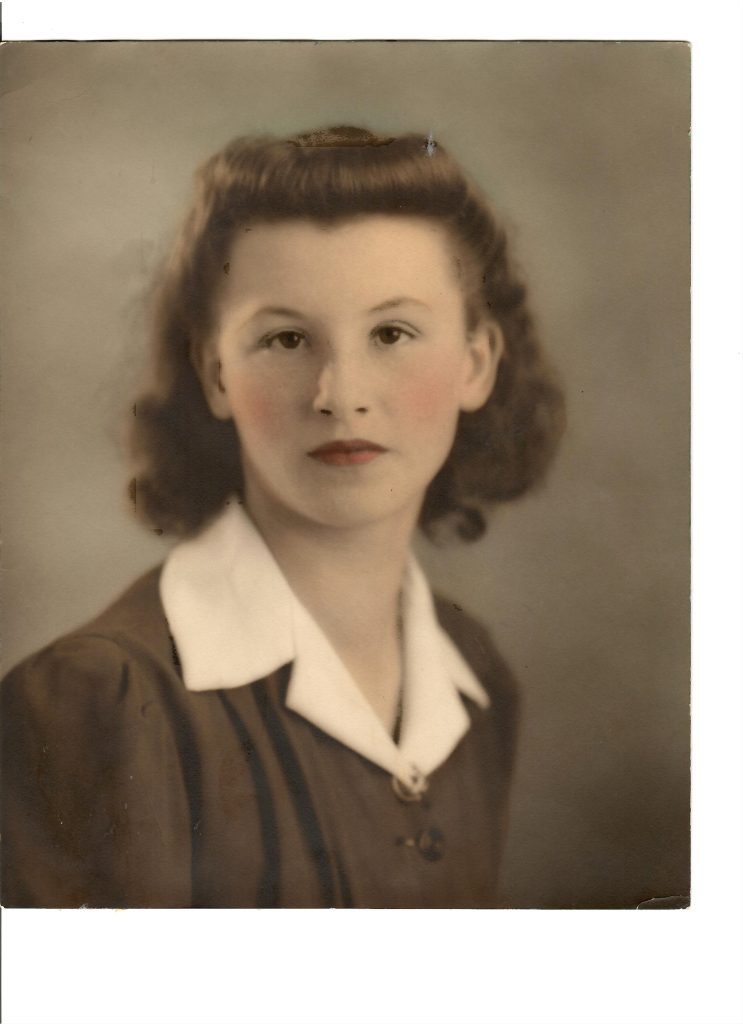
Fred was a nice gentle man but was difficult to get agreement on most things. He was adamant that a middle name was just a nuisance as he often had army cheques made out to Henry Fred and had difficulty cashing them. Hence Ronald Liepert. His stubbornness would play a major part in shaping my career.
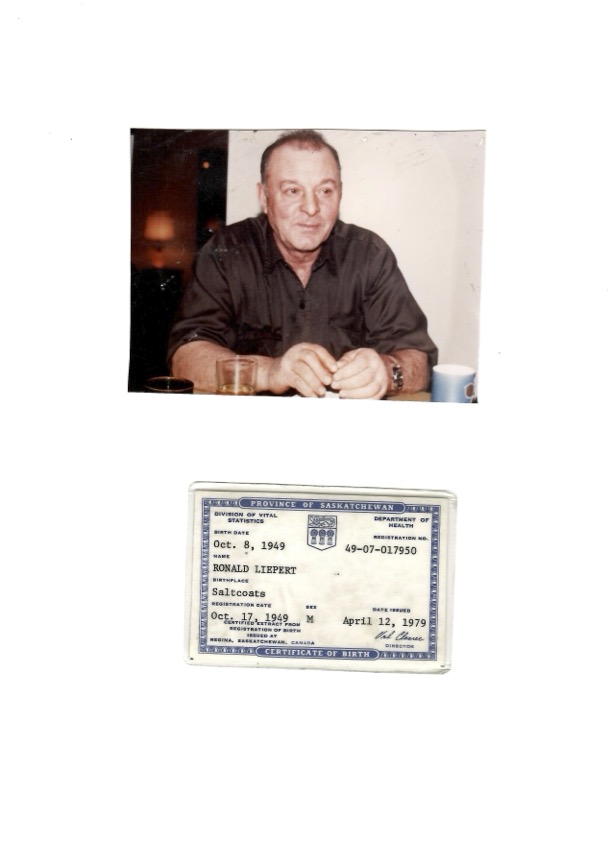
Four years after entering the world my sister Judy was born and like clockwork another 4 years later it was brother Dave on September 1, 1957. The 5 of us lived in a small house with no electricity until I was about 15. We had no indoor water or sewer, so it was an outhouse on cold winter nights. This and passing the evening hours away under a coil-oil lamp was a time I would rather forget.
A few years after leaving the army Fred bought a section of farmland 6 miles northeast of Saltcoats, about a half hour drive from the city of Yorkton. As a veteran he had privileges through the VLA to acquire land. This decision was made following their marriage and being away for a year or two working in Ontario picking tobacco, among other jobs.
The section Fred acquired through VLA did not have an acre of cultivated land. His older brother Edward and younger brother Albert had now assumed the home section about 5 miles north of Fred’s land. They helped Fred get established since the farm equipment had been inherited from their parents. Helen’s parents farmed a quarter section across the road from Fred’s land.
Helen performed the role of obedient farm wife very well. We had around a dozen cows which were milked by hand, a few hogs and about 100 chickens. My mother always had a large garden, preserving a host of vegetables and wild fruit. Very few meals at our house growing up did not entirely come from the land. We sold cream and eggs throughout the year and in the fall, cattle hogs and chickens.
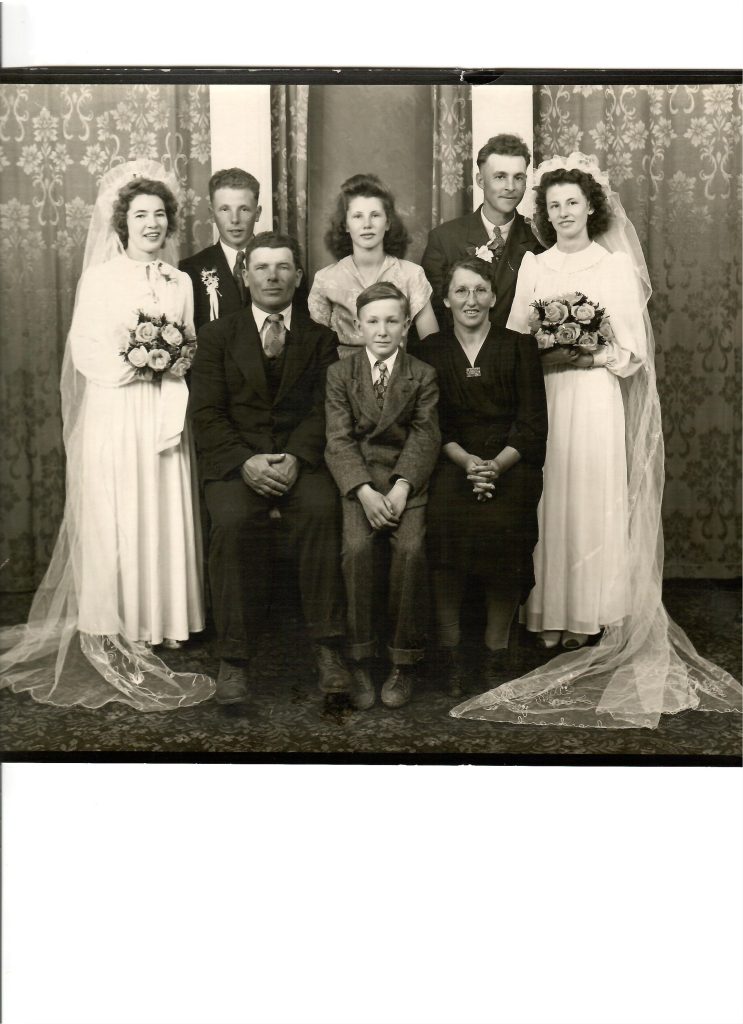
Not surprisingly I don’t remember much of my first 10 years. What I do remember was farm work was hard and money was scarce.
Click this link for additional early years and pictures.
One memory of those early years was the passing of grandfather Hudak in 1958. My younger brother Dave was just under 2 at the time and grandfather Hudak had terminal cancer and was at an old facility (today it would be called a hospice) with no air conditioning at Yorkton airport.
Fred and Helen would go to comfort him and the 3 kids stayed in the car with Uncle Albert (Fred’s brother) and his wife Shirley. Dave screamed throughout the entire time my parents were gone, making my aunt and uncle very upset. My sister and I were very embarrassed.
All one could hear through the open windows was my grandfather’s moaning in pain. Cancer patients weren’t given morphine then and the pain must have been excruciating. Hungarians didn’t scream they just yelled “Yoy, yoy, yoy yoy.” It is interesting how times have changed. He died at age 59 and I remember people at the service saying,
“He had a full life.” Today that is considered extremely young.
Sports was always my number one interest. About once a week the family would travel to Yorkton to deliver cream to the creamery. My parents would pick up groceries, and I was given an allowance, probably about $.25 which was always used to buy a hockey or baseball magazine. Pictures would be scrounged from wherever to make a scrapbook.
Organizing sports events started at a young age. Neighbourhood boys would gather in our field for a game of pick-up football on a Sunday afternoon.
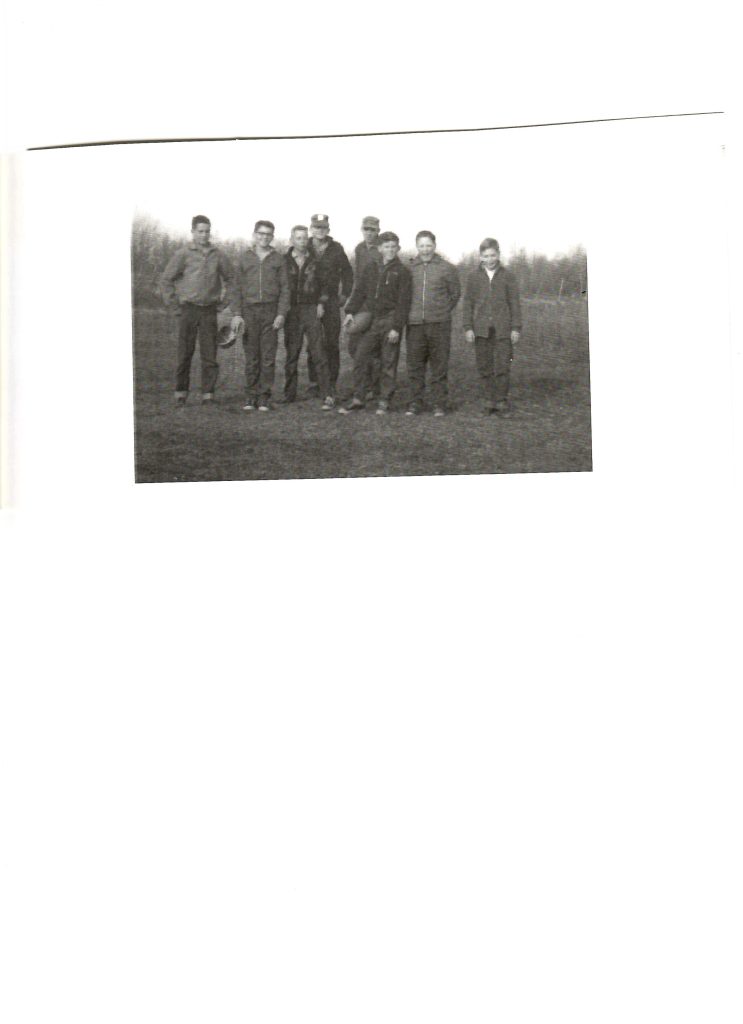
From left to right: Nelson Rodgers, Howard Kirkham, Tim Jacobs, Perry Kirkham, me, Jeff Kirkham, Keith Kirkham, Dan Kirkham
About once per week our family would visit with the Sek family, usually Sunday night to watch Bonanza on TV. Ed and Albin became good friends, and Ed delivered the eulogy for my father’s funeral. Fred died of cancer in 1995 and Helen passed away 3 years later also from cancer.
Click here to read Fred’s obit, Ed Sek eulogy, Helen’s obit and kid’s eulogy
School Years
I began school about 3 miles from home in the Graham district. Marguerite Bradford was the teacher in a one room schoolhouse for all 6 grades, in total around 30 kids. There were 6 in our class, 3 boys and 3 girls.
Helen Torrie, Linda Trowel, Marlene Toth, Perry Kirkham, Ronald Torrie and I were in first grade. At some point Muriel Willis joined the group and eventually 7 of us went on to take grades 7 & 8 at Saltcoats elementary.
Both Ronald Torrie and Perry Kirkham were skilled students and went on to attain university degrees. However, both returned to the Saltcoats area and farmed most of their lives. Unfortunately, both have passed away. Torrie died of a heart attack the night before a 50th, high school reunion in 2017 and Kirkham several years prior.
Grades 7 & 8 meant taking a school bus to the town of Saltcoats (population 500) one grade per classroom in a school that had approximately 200 students. I don’t recall my teachers in grades 7 and 8 but do recall that school was always a struggle.
Saltcoats didn’t have junior high, just elementary and high school. Our high school was quite modern, especially compared to the elementary school and had students from a wider surrounding area as some rural schools provided grades 1 through 8. I never liked books much but did enjoy the sporting activities and recess.
My entrance to high school coincided with the arrival of a new principal, Mr. Gross. Rumor had it he was fired from a previous role and hoisted onto Saltcoats. Mr. Gross, a nice man but legally blind, was way in over his head. Discipline didn’t exist and chalk fights took place at the back of the classroom throughout his entire math/algebra class. I’m sorry to say Ronald was one of the least disciplined.
Grade 9 was difficult but my teacher Mrs. Lowe from Bredenbury, the next little town about 6 miles east of Saltcoats on the Yellowhead highway, managed to get me passed onto grade 10.
History was a subject that we didn’t have until grade 10, or at least not ancient history. We had a wonderful teacher Mrs. Sinclair who lived early British history 24 hours a day. I couldn’t care less who the King of England was in the 1400’s. I recall scoring 8%, yes 8 out of 100, on the first history exam in the fall of 1964. It didn’t get a lot better as the year progressed and I ended up repeating grade 10.
By this time, I had lost interest in school but passed onto grade 11 although firmly believe a few of us were moved up so we would be that much closer to leaving school behind.
Grade 11 saw a major changeover in teaching staff including a new Principal, Mr. Hrytsak, who many of us thought had served time administering a German concentration camp. The teachers, other than Mrs. Lowe, were all from Yorkton and carpooled each day. Obviously, their attachment to the community was pretty much zero.
At some point during the year, Mr. Hrytsak had a nervous breakdown and had to leave. He was replaced by the local United Church Minister Walter Farquharson who later went on to be the moderator for the United Church of Canada.
By 1966-67 I was pretty much done with attending class. I enjoyed going to school for the activities and camaraderie but nothing else. I failed several classes in grade 11 and did not advance to grade 12.
While I was in grade 11 it was decided the current school year would be the last for high school classes in Saltcoats and grades 10-12 would travel to Yorkton in the fall of 1967.
That held no appeal to me and since post-secondary wasn’t an option I decided not to return in the fall of 1967, discontinue my education and find a job. I referred to this as my centennial project.
We caught the old yellow school bus at our driveway, but it was not uncommon for it to be cancelled in a Saskatchewan winter storm. One of my best memories of going to school in Saltcoats was with the slightest threat of bad weather, I stayed at Nana’s house. She had electricity, television and was a great cook.
Talking about my early years would not be complete without mentioning Nana. Born in 1903 in Budapest her husband John, son John Jr and daughter Helen immigrated to Canada in 1929. They farmed a quarter of a section across the road from the land my parents would later purchase. After John’s passing in 1958 she moved into a small house in Saltcoats. It was here that I would stay during winter storms and walk to school.
Nana never really tried to learn English so communicating with her was often difficult. Like so many Eastern Europeans Nana was a fantastic cook. She made the best fried chicken in the world. She also had such a temper so don’t get her mad.
Nana had two other children, Jenny and Andy, who were younger than Helen. Andy was my idol when growing up. He worked on heavy construction in B.C. He made very good money but like his father, drank way too much. Nana didn’t drink and after dealing with her husband’s drinking all her life would get very frustrated with her son’s drinking when he came home once a year at Christmas.
We would always go to Nana’s house on Christmas Eve. Andy would usually arrive in Saltcoats by vehicle at some point that day and go straight to the bar and meet his buddies. The bar closed at 6 PM and he would show up shortly after at Nana’s house quite inebriated but always ready for a good time.
One Christmas Eve, Andy was a few minutes late and Nana was very angry. She disappeared for awhile and we all wondered where she had gone. My mom finally went out to the porch and discovered Nana standing behind the door with a cast iron frying pan waiting for her son to arrive. It was a blessing that she was disarmed shortly before Andy showed up. Nana lived until 95 years of age and passed away in 1998.
1928 immigration papers for – John, Elizabeth & Helen Elizabeth Hudak;
Nana, with Kylee and Cody
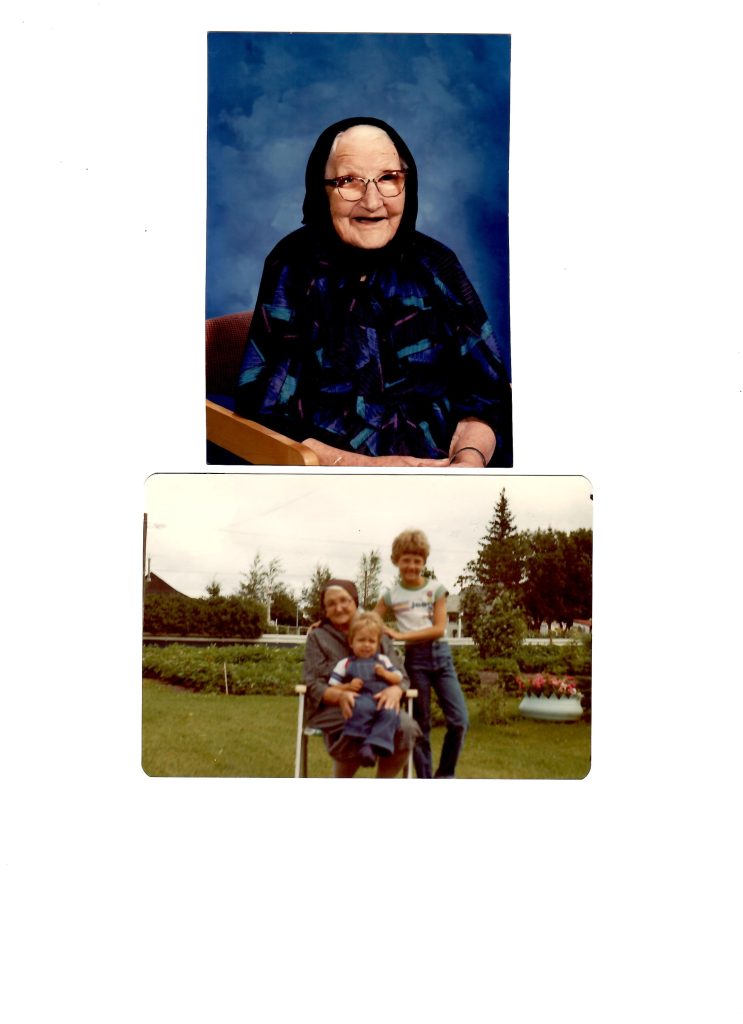
Fred and Helen Liepert later in life